
Class 6 Worksheet on Shades of Meaning (Intensity)

Class 6 Worksheet on Shades of Meaning (Intensity)
Power Words in Action: Shades of Meaning (Intensity Scale) for Class 6
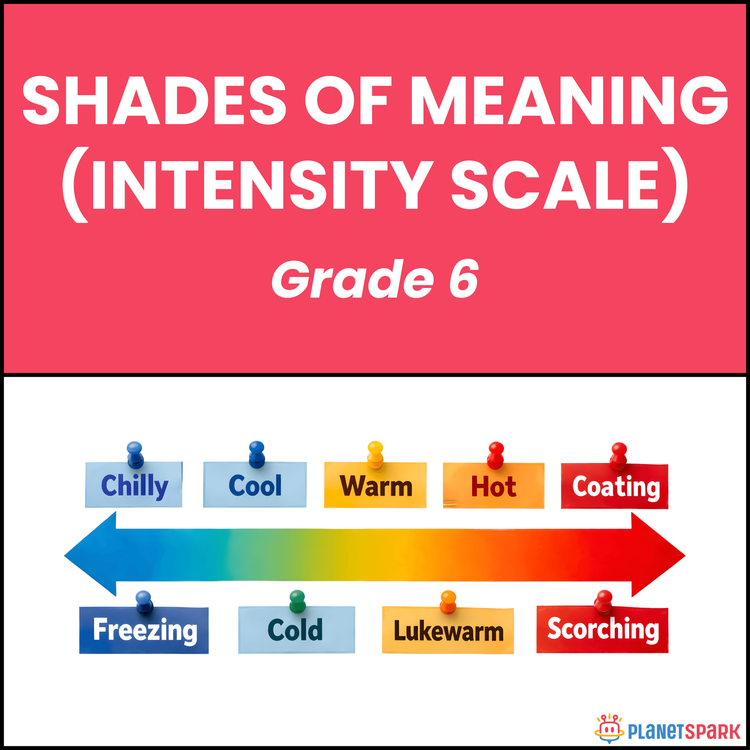
This Grade 6 worksheet focuses on Shades of Meaning (Intensity Scale) and helps students understand how words with similar meanings can vary in strength or intensity.
Through engaging and structured exercises, learners explore how to choose more precise and impactful words in both writing and speaking. The worksheet includes a variety of task types such as true/false, match the following, fill in the blanks, multiple choice questions, and sentence rewriting.
Why Shades of Meaning Matter in Grammar?
Understanding shades of meaning helps students become more expressive and accurate communicators. For Grade 6 learners, this topic is important because:
1. It builds vocabulary depth by showing differences between similar words.
2. It helps students choose stronger and more precise words in writing.
3. It improves reading comprehension and interpretation.
4. It enhances creative and descriptive language skills.
What’s Inside This Worksheet?
This worksheet includes five grammar-rich activities that strengthen understanding of word intensity:
Exercise 1 – True or False
Students identify whether statements about word intensity are correct or incorrect, helping them build conceptual clarity.
Exercise 2 – Match the Following
Students match base words with their more intense counterparts (e.g., “hungry” → “famished”), reinforcing vocabulary relationships.
Exercise 3 – Fill in the Blanks
Students' complete sentences using stronger words to enhance meaning and expression.
Exercise 4 – Multiple Choice Questions
Students select the most appropriate intense synonym in context, improving word choice accuracy.
Exercise 5 – Sentence Rewriting
Students rewrite sentences by replacing weaker words with stronger alternatives, developing expressive writing skills.
Answer Key (For Parents & Educators)
Exercise 1 – True/False
1. True
2. True
3. False
4. True
5. False
6. True
7. True
8. True
9. False
10. False
Exercise 2 – Match the Following
1. Dislike - Loathe
2. Small - Microscopic
3. Upset - Devastated
4. Warm - Scorching
5. Hungry - Famished
6. Dirty - Filthy
7. Eat - Devour
8. Ask - Interrogate
9. Silly - Ridiculous
10. Pull - Yank
Exercise 3 – Fill in the Blanks
1. enormous / gigantic / colossal
2. boiling / scalding
3. outstanding / excellent / superb
4. microscopic / tiny
5. dazzling / brilliant
6. hurricane / gale / storm
7. blistering / sweltering / scorching
8. spotless / immaculate
9. pound / bang
10. hilarious
Exercise 4 – Multiple Choice Questions
1. b) drenched
2. a) miserable
3. c) magnificent
4. d) adored
5. b) towering
6. a) thundered
7. d) baffling
8. c) radiant
9. a) positive
10. b) howled
Exercise 5 – Sentence Rewriting
1. The tiny elevator with twenty passengers was highly (packed / crammed)
2. The frightened deer began to (sprint / dash / bolt) from the loud noise.
3. The heavy iron hammer will completely (shatter / smash / crush) the glass.
4. The lost toddler started to loudly (sob / bawl / weep) in the busy store.
5. The magical diamond began to brightly (radiate / gleam / dazzle) in the dark cave.
6. The scared rock climber tried to tightly (clutch / grip / grasp) the safety rope.
7. The broken satellite started to (plummet / plunge / tumble) from outer space.
8. The starving wild wolves will quickly (devour / consume / gobble) the fresh meat.
9. The sneaky seagull swooped down to (snatch / swipe / seize) the tasty sandwich.
10. The athletic police dog managed to (leap / bound / vault) over the tall fence.
Upgrade your child’s vocabulary and expression skills with expert-led grammar sessions designed for real communication success.
Book a free trial!
Frequently Asked Questions
Shades of meaning refer to slight differences in the intensity or degree of similar words, helping students choose the most accurate word for a given context.
Understanding word intensity helps students to express themselves more accurately, making their speech and writing more natural and engaging.
Using words with the right intensity helps avoid confusion, allowing students to convey their ideas more clearly and convincingly.