
Class 6 Grammar Worksheet on Part-Whole Analogies

Class 6 Grammar Worksheet on Part-Whole Analogies
Parts to Whole Power: Mastering Part–Whole Analogies for Class 6
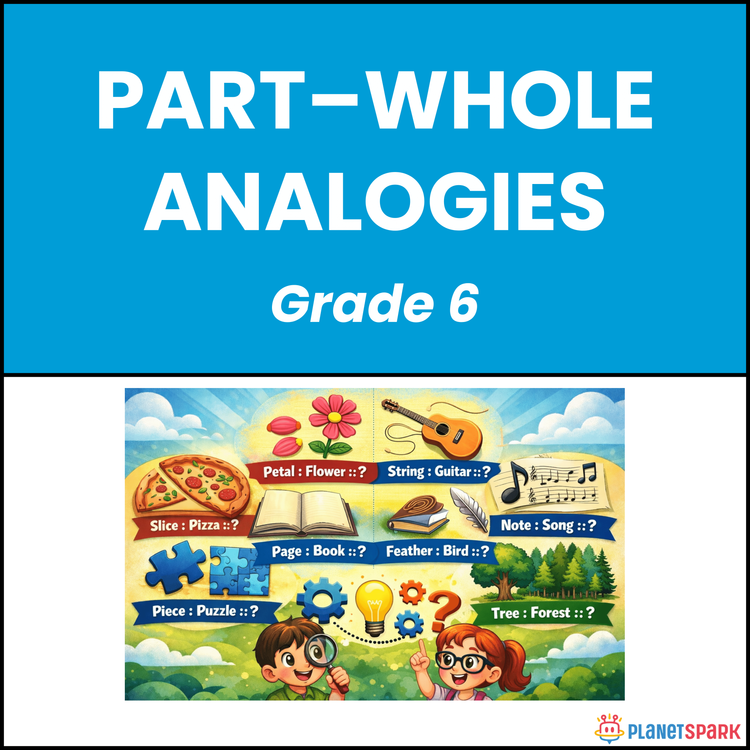
This Grade 6 English grammar worksheet focuses on Part–Whole Analogies, helping students understand how smaller components relate to larger objects in a meaningful and structured way. Through engaging and thoughtfully designed exercises, learners build logical reasoning, vocabulary, and analytical thinking skills essential for strong language development.
Why Part–Whole Analogies Matter in Grammar?
Part–whole analogies strengthen a child’s ability to identify relationships between objects and ideas. For Grade 6 learners, this topic is important because:
1. It develops logical reasoning and critical thinking skills.
2. It helps students understand how parts contribute to a complete structure.
3. It improves vocabulary by connecting related words meaningfully.
4. It enhances comprehension skills useful in reading and writing.
What’s Inside This Worksheet?
This worksheet includes five grammar-rich activities that build mastery in part–whole relationships:
Exercise 1 – True or False
Students read statements about part–whole analogies and identify whether they are correct or incorrect, building conceptual clarity.
Exercise 2 – Match the Following
Students match parts with their correct wholes, reinforcing their understanding of real-world object relationships.
Exercise 3 – Fill in the Blanks
Students complete analogies by identifying the correct whole based on the given part, strengthening reasoning and vocabulary.
Exercise 4 – Multiple Choice Questions
Students select the correct answers from given options to complete part–whole analogies, improving decision-making and accuracy.
Exercise 5 – Sentence Rewriting
Students correct incorrect analogies by replacing the wrong word with the correct whole, enhancing analytical and editing skills.
Answer Key (For Parents & Educators)
Exercise 1 – True or False
1. True
2. True
3. False
4. True
5. False
6. False
7. True
8. False
9. True
10. True
Exercise 2 – Match the Columns
1. Bristle : Brush
2. Chorus : Song
3. Deck : Ship
4. Antenna : Insect
5. Equator : Earth
6. Lens : Camera
7. Article : Magazine
8. Yolk : Egg
9. Brick : Wall
10. Pupil : Eye
Exercise 3 – Fill in the Blanks
1. Loaf / Cake / Pie
2. Mug / Basket
3. Horse / Cow / Pig
4. Camel
5. Pants / Trousers / Jeans
6. Shark / Fish / Dolphin
7. Boot / Shoe
8. Jar / Box / Pot
9. Bed
10. Pie / Bread / Pizza
Exercise 4 – Multiple Choice Questions
1. b) octopus
2. a) tree
3. d) sneaker
4. c) staircase
5. a) camel
6. c) helmet
7. b) sentence
8. d) butterfly
9. a) belt
10. c) porcupine
Exercise 5 – Sentence Rewriting (Corrected Sentences)
1. A leaf is to a branch as a root is to a plant (or tree).
2. A handle is to a mug as a strap is to a backpack (or bag / purse).
3. A leg is to a table as an arm is to a body (or person / chair).
4. A wheel is to a bike as a screen is to a television (or phone / computer).
5. A slice is to a cake as a piece is to a puzzle (or pie / game).
6. A petal is to a flower as a page is to a book (or notebook / diary).
7. A finger is to a hand as a toe is to a foot.
8. A drop is to rain as a grain is to sand (or rice / salt).
9. A window is to a room as a roof is to a house (or building / cabin).
10. A letter is to a word as a musical note is to a song (or melody / sheet music).
Build your child’s reasoning skills with fun and interactive analogy practice that makes grammar meaningful and engaging.
Book a free trial!
Frequently Asked Questions
Part-whole analogies show the relationship between a whole and its parts, helping students understand how things are connected.
A simple examples include "finger:hand," "page:book," and "seed:plant," showing how smaller parts make up a complete object.
They focus on how parts contribute to a whole, unlike synonym or antonym analogies that compare meanings or opposites.