
Class 6 Formal and Informal Synonyms Worksheet

Class 6 Formal and Informal Synonyms Worksheet
Formal vs Informal Language: Synonyms for Class 6
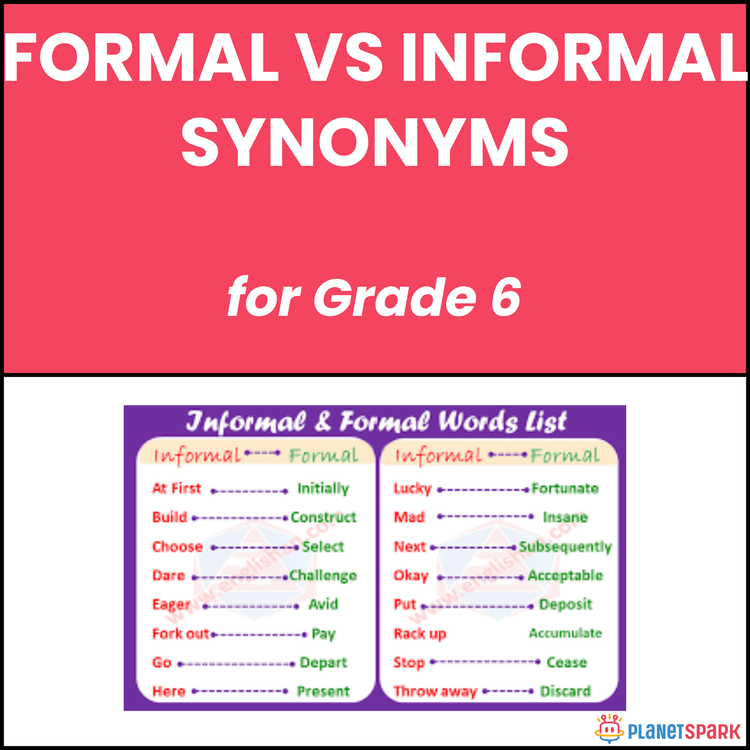
This Grade 6 worksheet helps students understand the difference between formal and informal synonyms. Learners practice choosing the appropriate word depending on the context, improving both writing style and communication skills.
Why Formal vs Informal Synonyms Matter in Grammar?
Using the right level of language is essential for clear communication. For Grade 6 learners, this topic is important because:
1. It helps students understand when to use formal and informal words.
2. It improves writing for different contexts like essays and conversations.
3. It builds strong academic and everyday vocabulary.
4. It enhances clarity and appropriateness in communication.
What’s Inside This Worksheet?
This worksheet includes five structured exercises designed for step-by-step learning:
Exercise 1 – True or False
Students identify whether the formal or informal usage is correct.
Exercise 2 – Sort the Words
Students sort word pairs into formal and informal synonyms.
Exercise 3 – Fill in the Blanks
Students choose the correct formal or informal word based on context.
Exercise 4 – Multiple Choice Questions
Students select the correct formal synonym.
Exercise 5 – Sentence Rewriting
Students rewrite sentences by replacing informal words with formal synonyms.
Answer Key (For Parents & Educators)
Exercise 1 – True / False
1. True
2. True
3. False
4. False
5. True
6. False
7. True
8. True
9. False
10. True
Exercise 2 – Sort the Words
Formal Words:
Repair
Retain
Demonstrate
Commence
Utilize
Inquire
Purchase
Obtain
Assist
Inform
Require
Depart
Attempt
Terminate
Informal Words:
Fix
Keep
Show
Start
Use
Ask
Buy
Get
Help
Tell
Need
Leave
Try
End
Exercise 3 – Fill in the Blanks
1. inform
2. told
3. implement
4. explain
5. commence
6. provide
7. depart
8. include
9. require
10. grant
Exercise 4 – Multiple Choice Answers
1. a) purchase
2. b) inquire
3. c) assist
4. d) commence
5. a) terminate
6. d) informed
7. b) depart
8. c) require
9. c) obtained
10. d) children
Exercise 5 – Sentence Rewriting (Sample Answers)
1. He purchased a new laptop yesterday.
2. They commenced the meeting late.
3. The teacher informed us of the answer.
4. She inquired for help during class.
5. We require more information now.
6. The workers departed the office early.
7. The team assisted the new player.
8. The show terminated very quickly.
9. He obtained a prize in school.
10. The manager stated the final decision.
Help your child master formal and informal language with structured practice and expert guidance.
Book a free trial!
Frequently Asked Questions
Formal synonyms are used in academic or polite contexts, while informal synonyms are used in everyday conversation.
It helps students use appropriate language in exams, writing tasks, and real-life communication.
Students can compare sentences and choose words based on the situation, such as school writing versus casual speech.