
Class 6 Formal and Informal Antonyms Worksheet

Class 6 Formal and Informal Antonyms Worksheet
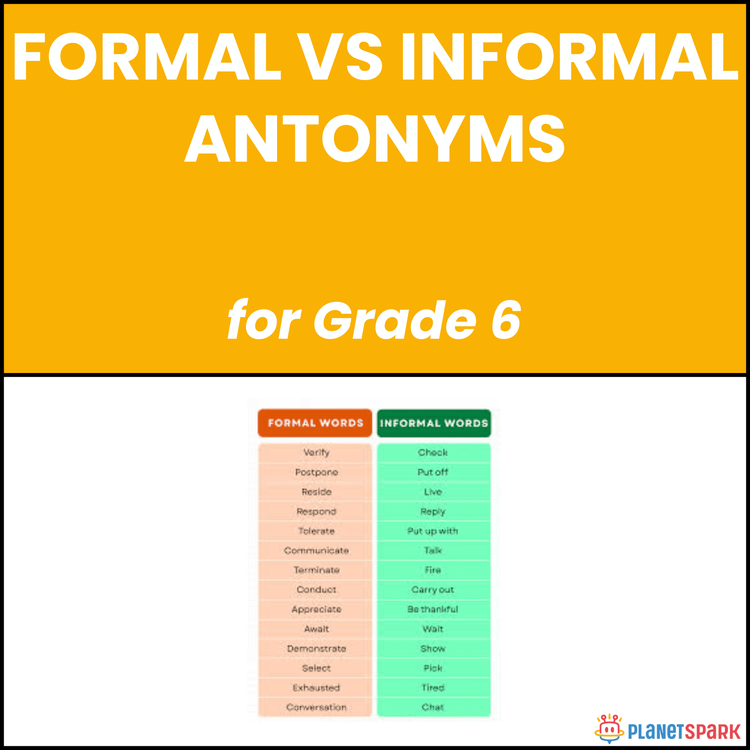
Opposites in Action: Formal vs Informal Antonyms for Class 6
This Grade 6 worksheet helps students understand antonyms in both formal and informal contexts. Learners explore how words like “buy” and “purchase” or “leave” and “depart” relate in meaning, and how antonyms can differ depending on usage style.
Why Formal vs Informal Antonyms Matter in Grammar?
Understanding formal and informal antonyms helps students use language appropriately in different contexts. For Grade 6 learners, this topic is important because:
1. It builds awareness of word choice in formal and everyday communication.
2. It improves vocabulary with both simple and advanced word forms.
3. It strengthens understanding of opposites and synonyms together.
4. It enhances writing skills for different situations like school work and conversation.
What’s Inside This Worksheet?
This worksheet includes five structured exercises designed for effective grammar learning:
Exercise 1 – True or False
Students identify whether word pairs show correct opposite or same meanings. :contentReference[oaicite:0]{index=0}
Exercise 2 – Sort the Words
Students classify word pairs into antonyms and not antonyms based on meaning. :contentReference[oaicite:1]{index=1}
Exercise 3 – Fill in the Blanks
Students choose the correct antonym from given pairs to complete each sentence. :contentReference[oaicite:2]{index=2}
Exercise 4 – Multiple Choice Questions
Students select the correct antonym to complete sentences meaningfully. :contentReference[oaicite:3]{index=3}
Exercise 5 – Sentence Rewriting
Students rewrite sentences by replacing highlighted words with their correct antonyms.
Answer Key (For Parents & Educators)
Exercise 1 – True / False
1. False
2. False
3. True
4. True
5. True
6. False
7. True
8. True
9. True
10. True
Exercise 2 – Sort the Words
Antonyms:
open / closed
up / down
in / out
early / late
arrive / depart
enter / exit
give / receive
build / destroy
lend / borrow
win / lose
Not Antonyms:
help / assist
start / finish
ask / question
begin / start
buy / purchase
Exercise 3 – Fill in the Blanks
1. exit
2. depart
3. receive
4. destroy
5. finish
6. close
7. end
8. catch
9. stop
10. leave
Exercise 4 – Multiple Choice Answers
1. b) depart
2. a) end
3. d) destroy
4. a) exit
5. c) finish
6. b) receive
7. c) close
8. d) stop
9. c) throw
10. d) depart
Exercise 5 – Rewritten Sentences
1. The teacher will begin the class in the morning.
2. He will enter the room when the bell rings.
3. The show will start in the evening.
4. The workers will build the old bridge.
5. She will give a gift from her friend.
6. The shop will open at 9 a.m.
7. The boy will catch the ball to his friend.
8. We will arrive from the station at 6 a.m.
9. They will continue the meeting after lunch.
10. The train will depart at the platform on time.
Help your child build strong vocabulary and learn how to use formal and informal word choices effectively with this practical grammar worksheet.
Frequently Asked Questions
Formal antonyms are used in academic or polite contexts, while informal antonyms are used in everyday speech, both showing opposite meanings.
It helps students choose the right opposite words based on context, improving both writing and communication skills.
Students can compare sentence contexts and select antonyms suitable for formal writing or casual conversation.