
Class 6 Basic Antonyms Common Words Worksheet

Class 6 Basic Antonyms Common Words Worksheet
Opposites Made Easy: Basic Antonyms (Common Words) for Class 6
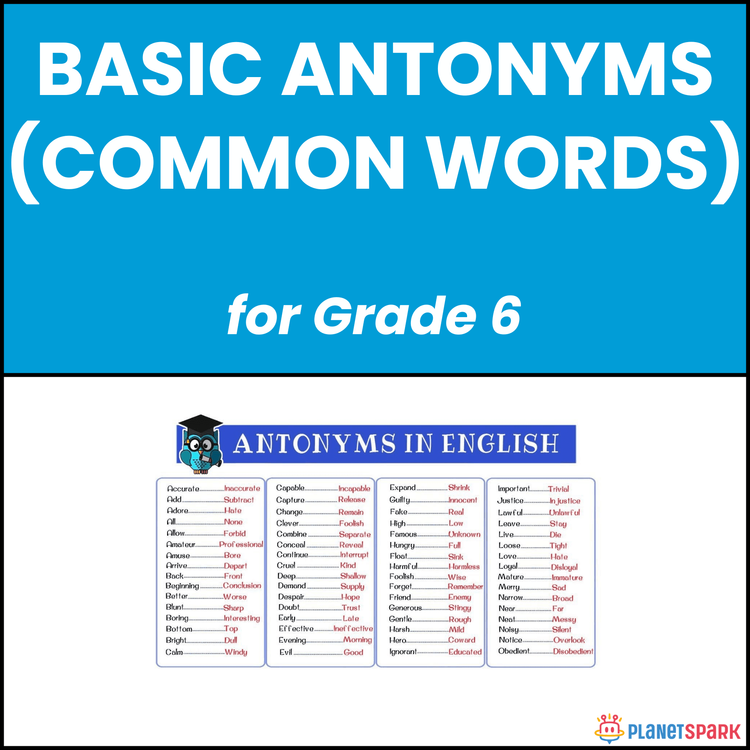
This Grade 6 worksheet helps students understand basic antonyms using common everyday words. Learners practice identifying opposite meanings in different contexts, improving vocabulary and comprehension skills.
Why Basic Antonyms Matter in Grammar?
Understanding antonyms is essential for clear communication. For Grade 6 learners, this topic is important because:
1. It helps students recognise opposite meanings of common words.
2. It improves vocabulary and language understanding.
3. It strengthens reading comprehension.
4. It builds a strong foundation for advanced grammar concepts.
What’s Inside This Worksheet?
This worksheet includes five structured exercises designed for step-by-step learning:
Exercise 1 – True or False
Students identify whether given word pairs are antonyms.
Exercise 2 – Sort the Words
Students sort word pairs into antonyms and not antonyms.
Exercise 3 – Fill in the Blanks
Students choose the correct antonym based on sentence context.
Exercise 4 – Multiple Choice Questions
Students select the correct antonym for the given word.
Exercise 5 – Sentence Writing
Students write sentences using antonyms of given words.
Answer Key (For Parents & Educators)
Exercise 1 – True / False
1. True
2. True
3. False
4. True
5. True
6. False
7. True
8. True
9. True
10. True
Exercise 2 – Sort the Words
Antonyms:
Big – Small
Hot – Cold
Happy – Sad
Fast – Slow
Day – Night
Open – Close
Up – Down
Young – Old
Full – Empty
Tall – Short
Not Antonyms:
Book – Pen
Dog – Cat
Sun – Moon
Car – Bus
Pen – Pencil
Exercise 3 – Fill in the Blanks
1. hot
2. big
3. happy
4. fast
5. tall
6. open
7. up
8. full
9. young
10. early
Exercise 4 – Multiple Choice Answers
1. b) cold
2. a) small
3. c) sad
4. d) slow
5. c) short
6. b) light
7. d) short
8. a) dark
9. c) empty
10. d) late
Exercise 5 – Sentence Writing (Sample Answers)
1. The turtle moves slow.
2. The box is small.
3. The water is cold.
4. The boy felt sad.
5. The glass is empty.
6. The tree is short.
7. The door is closed.
8. The bag is heavy.
9. The man is old.
10. The train arrived late.
Help your child build strong vocabulary and master antonyms with fun and engaging practice.
Frequently Asked Questions
Basic antonyms are words with opposite meanings, such as hot and cold, helping students understand contrasts in vocabulary.
Learning antonyms improves vocabulary, enhances comprehension, and helps students express opposite ideas clearly in writing.
Students can match opposite words, use them in sentences, and practice regularly to build strong language skills.