Class 4 Worksheet On Homophones (allowed-aloud)
Class 4EnglishEnglish GrammarFree DownloadPDF

Abshar AfrozVisit Profile
I am an enthusiastic English educator with a strong passion for helping students develop confidence in communication. At Planet Spark, I specialize in teaching Public Speaking and Creative Writing, guiding learners to express themselves clearly, think creatively, and speak with impact. Drawing on my teaching experience and warm, engaging style, I help children develop fluent English, powerful presentation skills, and a love for writing. My sessions are interactive, skill-focused, and designed to build both language proficiency and self-confidence in young minds.
Class 4 Worksheet On Homophones (allowed-aloud)
Class 4EnglishEnglish GrammarFree DownloadPDF
Abshar AfrozVisit Profile
I am an enthusiastic English educator with a strong passion for helping students develop confidence in communication. At Planet Spark, I specialize in teaching Public Speaking and Creative Writing, guiding learners to express themselves clearly, think creatively, and speak with impact. Drawing on my teaching experience and warm, engaging style, I help children develop fluent English, powerful presentation skills, and a love for writing. My sessions are interactive, skill-focused, and designed to build both language proficiency and self-confidence in young minds.
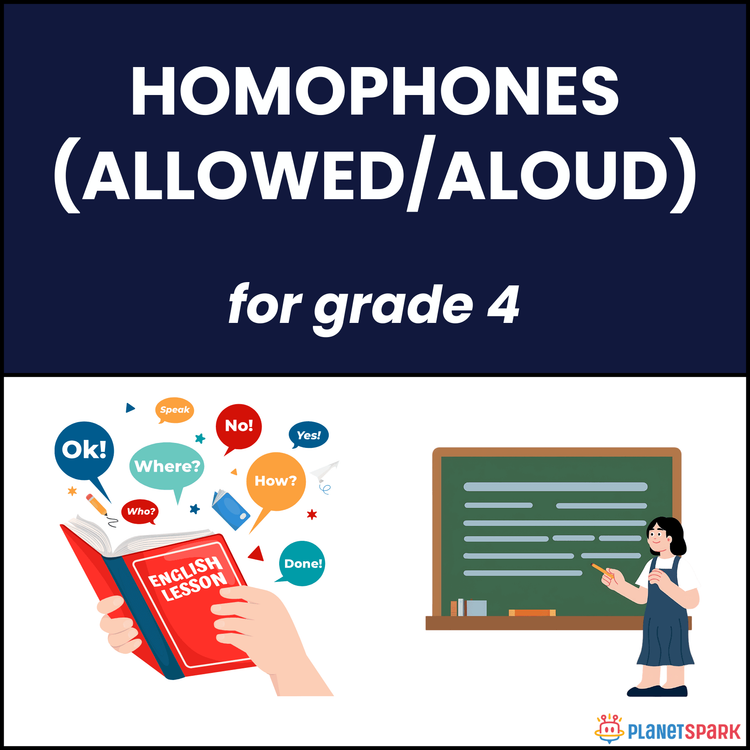
Grade 4 Worksheet: Homophones (Allowed/Aloud)
This Grade 4 worksheet is designed to help students understand and practice homophones, specifically the commonly confused pair: "allowed" and "aloud." Homophones are words that sound the same but have different meanings and spellings. Mastering homophones is crucial for clear writing and speaking.
In this worksheet, students will learn when to use "allowed" (meaning permitted) and "aloud" (meaning spoken or read out loud). The worksheet includes multiple exercises like True/False statements, word sorting, fill-in-the-blanks, and multiple-choice questions. These activities will help reinforce the differences between homophones and encourage students to use them correctly in sentences.
By completing this worksheet, students will improve their vocabulary, sentence structure, and understanding of how homophones work in different contexts.
*Why Learning Homophones is Important in Grammar?
Learning homophones helps students:
1. Understand and correctly use words that sound the same but have different meanings.
2. Improve spelling, as they will recognize the correct spelling for the intended meaning.
3. Enhance both their written and verbal communication by avoiding confusion between words.
4. Build stronger reading comprehension skills as they learn to identify homophones in context.
This worksheet is a great way for students to practice and understand the important differences between homophones like "allowed" and "aloud."
What’s Inside This Worksheet?
This worksheet includes a variety of fun and engaging exercises:
🧠 Exercise 1 – True or False
Students will evaluate statements about "allowed" and "aloud" to determine whether they are true or false.
✏️ Exercise 2 – Sort the Words
In this activity, students will sort pairs of homophones into "Homophones" and "Not Homophones."
📋 Exercise 3 – Fill in the Blanks
Students will fill in the blanks with the correct homophone from the provided pair, such as "allowed" or "aloud."
🔤 Exercise 4 – Multiple Choice Questions
In this activity, students choose the correct homophone for the sentence based on context.
📝 Exercise 5 – Sentence Rewriting
Students will rewrite sentences using the correct homophone, helping them understand their proper usage in context.
✅ Answer Key (For Parents & Educators)
Exercise 1 – True or False
1. False
2. True
3. False
4. True
5. False
6. True
7. True
8. False
9. True
10. True
Exercise 2 – Sort the Words
Homophones
- Allowed/Aloud
- Sun/Moon
- Pen/Paper
- Night/Knight
- Flower/Flour
Not Homophones
- Bare/Bear
- Brake/Break
- Book/Desk
- Knot/Not
- Right/Write
- Fish/Bird
- Son/Sun
- Meet/Meat
- Sea/See
- Their/There
Exercise 3 – Fill in the Blanks
1. aloud
2. chose
3. Ate
4. sun
5. quiet
6. wear
7. see
8. weight
9. sell
10. whether
Exercise 4 – Multiple Choice Questions
1. c) write
2. b) Sea
3. a) write
4. c) Park
5. a) Proud
Exercise 5 – Sentence Rewriting
1. She is allowed to speak aloud.
2. She was reading aloud in class.
3. This is their house.
4. They will be there soon.
5. The pear is sweet.
6. The right answer is correct.
7. I like to write in my notebook.
8. I can see the sea from my window.
9. I need to find the right answer.
10. I can see you.
Help your child confidently use conditional words like if and unless to express clear and logical ideas in writing.
🔖Book a free trial!
Frequently Asked Questions
Allowed and aloud are homophones because they sound the same but have different meanings and spellings. Allowed means permitted, while aloud means speaking out loud so others can hear. Learning them improves spelling and grammar skills in Class 4 English.
Students often confuse these words because they are pronounced the same. Understanding their meanings and practicing with sentence examples in a Class 4 grammar worksheet helps children use them correctly.
Children can practice by reading sentences, identifying the correct word based on meaning, and completing homophone exercises in Class 4 English worksheets designed for early learners.