
Class 4 English Worksheet on Idioms and Their Meanings

Class 4 English Worksheet on Idioms and Their Meanings
Everyday Expressions: Idioms and Their Meanings for Class 4
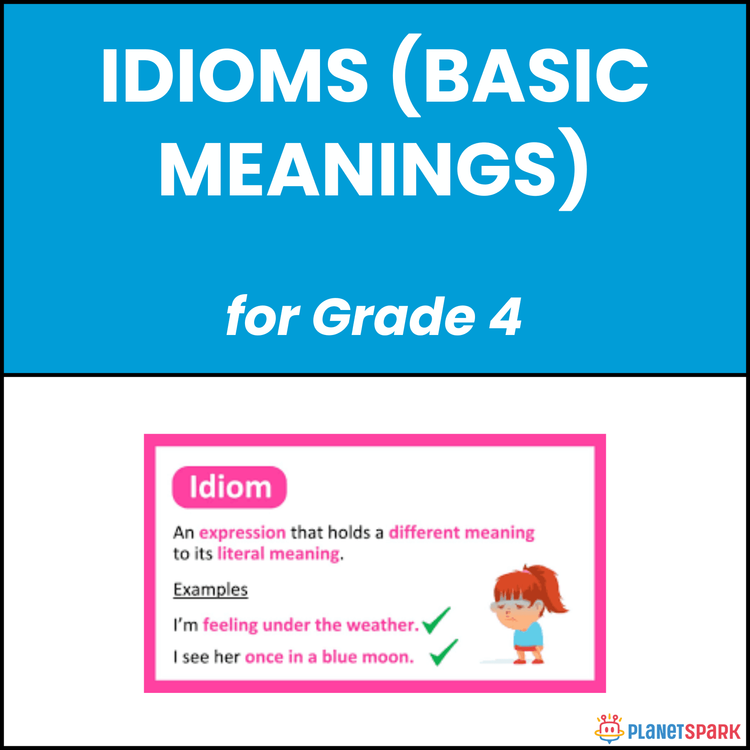
This Grade 4 English grammar worksheet introduces students to idioms and how they make everyday language more expressive and interesting. Idioms are phrases whose meanings are different from the literal meanings of the individual words. By learning idioms, students improve their vocabulary, reading comprehension, and conversational English skills.
In this worksheet, learners explore common idioms such as “piece of cake,” “spill the beans,” “on cloud nine,” and “under the weather.” Students practice identifying idioms in sentences, choosing the correct meaning of idiomatic expressions, rewriting sentences using suitable idioms, completing a paragraph with context-appropriate idioms, and writing their own sentences using idioms. These activities help children understand figurative language and apply it in real-life situations.
The exercises are designed specifically for Grade 4 learners and build practical grammar skills step by step. Students learn how idioms add color and emotion to language while strengthening their ability to interpret meaning beyond literal words.
Why Idioms Matter in Grammar?
Idioms make language more lively and expressive. For Grade 4 learners, understanding idioms is important because:
1. Idioms help students understand figurative language used in stories and conversations.
2. They improve vocabulary and language comprehension.
3. They make speaking and writing more natural and engaging.
4. They help learners interpret meanings based on context.
What’s Inside This Worksheet?
This worksheet includes five engaging grammar activities that help students recognize and use idioms correctly.
Exercise 1 – Underline the Idiom
Students read each sentence and underline the idiom if it appears in the sentence. If the sentence does not contain an idiom, they circle the sentence number.
Exercise 2 – Choose the Meaning
Students read each idiom and choose the correct meaning from three options. This helps learners understand what the idiomatic expression really means in context.
Exercise 3 – Sentence Rewriting
Students rewrite sentences using suitable idioms that express the same meaning as the original sentence.
Exercise 4 – Paragraph Completion
Students read a short paragraph and fill in the blanks using suitable idioms that best match the situation.
Exercise 5 – Sentence Writing
Students write three different sentences using each idiom provided. This encourages creative writing and helps students apply idioms in real-life contexts.
Answer Key (For Parents & Educators)
Exercise 1 – Underline the Idiom
1. piece of cake
2. circle
3. circle
4. circle
5. spilled the beans
6. break the ice
7. circle
8. hard nut to crack
9. on cloud nine
10. under the weather
Exercise 2 – Choose the Correct Meaning
1. a
2. b
3. b
4. a
5. c
6. a
7. b
8. a
9. b
10. b
Exercise 3 – Rewritten Sentences
1. The puzzle was a piece of cake for him.
2. Mehul felt under the weather yesterday.
3. Tanvi visits the museum once in a blue moon.
4. Riya was on cloud nine after winning the race.
5. The answer came to Kabir out of the blue during the test.
6. The math problem was a hard nut to crack for the class.
7. The teacher hit the nail on the head while explaining the answer.
8. The answer came to Kabir out of the blue during the test.
9. Neha tried to break the ice with the new student.
10. Ishan told his friend to hold your horses.
Exercise 4 – Paragraph Completion
1. break the ice
2. piece of cake
3. hit the nail on the head
4. on cloud nine
Exercise 5 – Sample Sentences
add fuel to the fire
His angry words added fuel to the fire.
Arguing again will only add fuel to the fire.
Complaining loudly added fuel to the fire.
call it a day
After finishing homework, we decided to call it a day.
The workers completed the task and called it a day.
The team practiced hard and then called it a day.
a blessing in disguise
Missing the bus turned out to be a blessing in disguise.
The rain delay was a blessing in disguise.
The mistake became a blessing in disguise.
in hot water
Riya was in hot water for breaking the window.
He got in hot water for forgetting his homework.
The student was in hot water after coming late.
get cold feet
I got cold feet before the speech.
She got cold feet before the competition.
He got cold feet before the performance.
the ball is in your court
I finished my part, now the ball is in your court.
The teacher explained everything, so the ball is in your court.
We helped you prepare, now the ball is in your court.
burn the midnight oil
Tanvi burned the midnight oil before the exam.
He burned the midnight oil to finish the project.
Students burn the midnight oil during exams.
costs an arm and a leg
That phone costs an arm and a leg.
The bicycle costs an arm and a leg.
The dress costs an arm and a leg.
pull someone’s leg
Kabir likes to pull his brother’s leg.
My friends pulled my leg during lunch.
She pulled my leg about the funny mistake.
let the cat out of the bag
Riya let the cat out of the bag about the surprise party.
He accidentally let the cat out of the bag.
The secret was revealed when she let the cat out of the bag.
Help your child understand idioms and speak English more confidently with fun figurative language practice and expert guidance.
Frequently Asked Questions
Idioms are phrases whose meanings are different from the literal meaning of the words, such as “spill the beans.” Class 4 English grammar worksheets help students learn these expressions and understand their real meanings.
Learning idioms helps early learners understand common expressions used in conversations and stories. Idiom practice in Class 4 English worksheets improves vocabulary and reading comprehension skills.
Idiom worksheets use matching activities, example sentences, and context clues to help students connect each phrase with its meaning. This approach strengthens vocabulary learning in Class 4 CBSE English grammar practice.