
Class 5 Worksheet on Compound Predicate No Comma

Class 5 Worksheet on Compound Predicate No Comma
No Comma Needed: Mastering Compound Predicates for Class 5
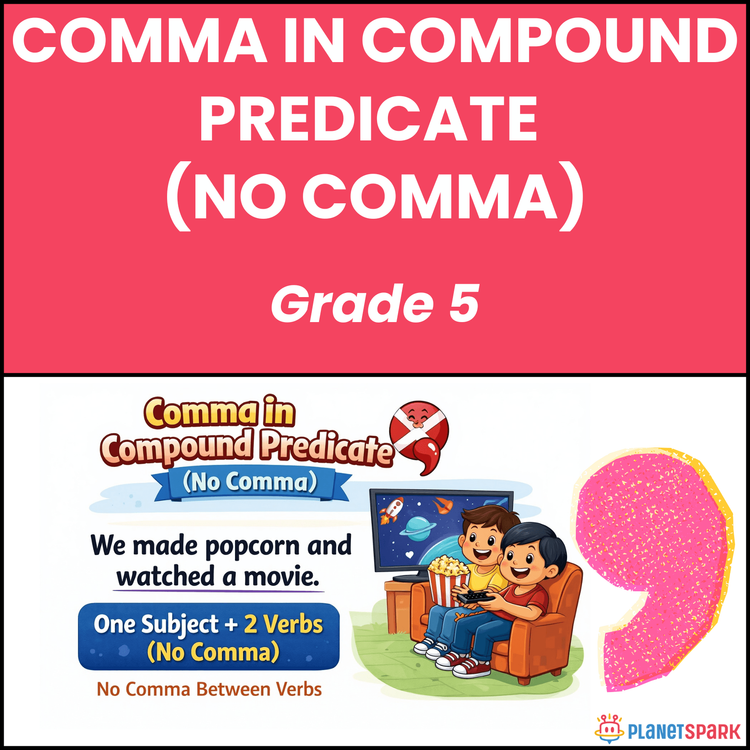
This Grade 5 worksheet focuses on helping students understand how to correctly use compound predicates without inserting unnecessary commas. A compound predicate occurs when a single subject performs two or more actions joined by a conjunction like *and* or *or*, and no comma is used between them. Through structured and engaging exercises, learners develop clarity and confidence in sentence construction.
Why Compound Predicates Matter in Grammar?
Compound predicates play a key role in building smooth and correct sentences. For Grade 5 learners, this topic is important because:
1. It teaches correct punctuation by avoiding unnecessary commas.
2. It improves sentence flow and readability.
3. It strengthens understanding of subjects and verbs working together.
4. It supports accurate writing in both academic and daily communication.
What’s Inside This Worksheet?
This worksheet includes five grammar-rich activities that help students master compound predicates without commas:
Exercise 1 – Multiple Choice Questions
Students choose the correctly written sentence that uses a compound predicate without an unnecessary comma.
Exercise 2 – True or False
Students identify whether each sentence correctly avoids commas in compound predicates, building strong editing skills.
Exercise 3 – Fill in the Blanks
Students complete sentences using suitable compound predicates joined correctly without commas.
Exercise 4 – Sentence Rewriting
Students correct sentences by removing incorrect commas and rewriting them properly.
Exercise 5 – Paragraph Writing
Students read a short paragraph and fix punctuation errors related to compound predicates, applying learning in context.
Answer Key (For Parents & Educators)
Exercise 1 – Multiple Choice Questions
1. b
2. a
3. c
4. b
5. a
6. c
7. b
8. a
9. c
10. b
Exercise 2 – True or False
1. True
2. False
3. True
4. False
5. True
6. True
7. False
8. True
9. False
10. True
Exercise 3 – Fill in the Blanks
1. runs and plays
2. eats and drinks
3. reads and writes
4. jumps and laughs
5. sings and dances
6. walks and talks
7. cleans and arranges
8. studies and practices
9. watches and learns
10. listens and understands
Exercise 4 – Sentence Rewriting
1. Riya runs and plays in the park.
2. Ravi eats and drinks after school.
3. Meera reads and writes neatly.
4. Raj jumps and laughs happily.
5. Asha sings and dances beautifully.
6. The teacher walks and talks to students.
7. Ravi cleans and arranges his desk.
8. Meera studies and practices daily.
9. Riya watches and learns new things.
10. Raj listens and understands the lesson.
Exercise 5 – Paragraph Writing
Answers may vary.
Build your child’s confidence in writing clear, smooth sentences by mastering compound predicates today.
Book a free trial!
Frequently Asked Questions
A compound predicate has two or more verbs sharing the same subject, showing multiple actions.
Commas are unnecessary because the verbs are not independent clauses; using one can break sentence flow.
Highlight the subject first, then underline all verbs linked to that subject to see the complete compound predicate.