
Class 5 English Worksheet on Editing Modal Verb Errors

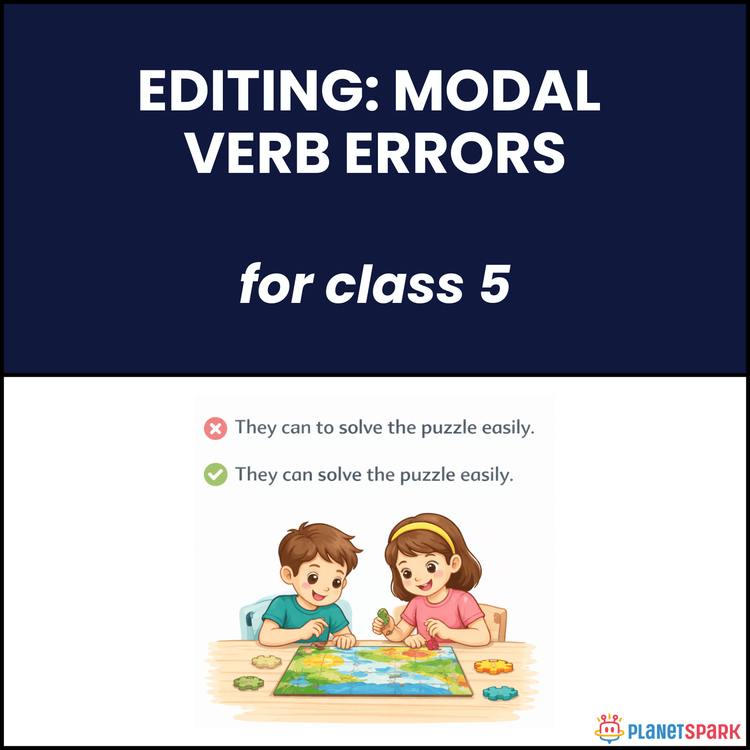
Class 5 English Worksheet on Editing Modal Verb Errors
Use It Right: Fixing Modal Verb Errors for Class 5
This Grade 5 worksheet focuses on identifying and correcting modal verb errors, helping students use helping verbs like can, could, should, must, may, and might correctly. Through structured and engaging exercises, learners build accuracy in sentence formation and improve their ability to express ideas clearly.
Why Modal Verbs Matter in Grammar?
Modal verbs are important for expressing ability, permission, possibility, and obligation. For Grade 5 learners, this topic is important because:
1. Modal verbs help express meaning beyond simple actions.
2. They are always followed by the base form of the verb.
3. They are essential for polite communication and clear instructions.
4. They improve both spoken and written English skills.
What’s Inside This Worksheet?
This worksheet includes five engaging exercises that build strong modal verb usage:
🧠 Exercise 1 – Underline the Modal Errors
Students identify incorrect usage of modal verbs in sentences. This builds awareness of common mistakes.
✏️ Exercise 2 – Multiple Choice Questions
Students choose the correct sentence with proper modal verb usage. This strengthens accuracy and understanding.
📋 Exercise 3 – Sentence Rewriting
Students rewrite sentences by correcting modal verb errors. This improves application skills.
📝 Exercise 4 – Paragraph Editing
Students find and correct modal verb errors in short paragraphs. This enhances contextual understanding.
🧩 Exercise 5 – Full Paragraph Correction
Students rewrite a paragraph by fixing all modal verb errors, building confidence in real-life writing.
✅ Answer Key (For Parents & Educators)
Exercise 1 – Modal Errors
1. to 2. to 3. comes 4. to 5. plays 6. finishes 7. to 8. helped 9. can 10. can
Exercise 2 – Multiple Choice Answers
1. a 2. b 3. c 4. b 5. c 6. c 7. b 8. b 9. c 10. a
Exercise 3 – Corrected Sentences
1. She will finish her homework before dinner.
2. They must follow the safety rules carefully.
3. I could solve the problem without any help.
4. He can run very fast during sports practice.
5. We should respect our teachers at school.
6. She may bring her lunch from home today.
7. You must wear your uniform every day.
8. They might visit their grandparents this weekend.
9. He will join us for the trip tomorrow.
10. I can write neatly in my notebook now.
Exercise 4 – Corrected Paragraphs
1. Aarav can solve difficult puzzles during class activities. He must finish his work on time and help others. His teacher says he might do even better next time.
2. Neha should complete her homework before going outside. She may bring her books to school every day. Her parents tell her she will improve if she practices more.
3. The players must follow the coach’s instructions carefully. They could play better if they worked as a team. The coach said they will win the next match.
Exercise 5 – Corrected Paragraph
Last weekend, Kabir and his cousins planned a small picnic near their home. They must bring all the necessary items and should pack their food carefully. Kabir will arrange the games for everyone to play. His sister could help him with the decorations and setup. They may invite their friends to join them for fun. Everyone was excited because they might enjoy the day together. Kabir’s parents said they will allow them if they follow the rules. It was going to be a fun day.
Help your child master modal verbs and express ideas clearly with structured grammar practice designed for real-world communication.
Frequently Asked Questions
Modal verbs like can, could, and should express ability, permission, or advice in sentences.
They often use the wrong modal or incorrect verb form after it, such as adding extra verbs.
Targeted English worksheets provide practice in choosing and using correct modals in context.